
How Do Top Content Platforms Differentiate Helpful Content from AI-Generated Content?
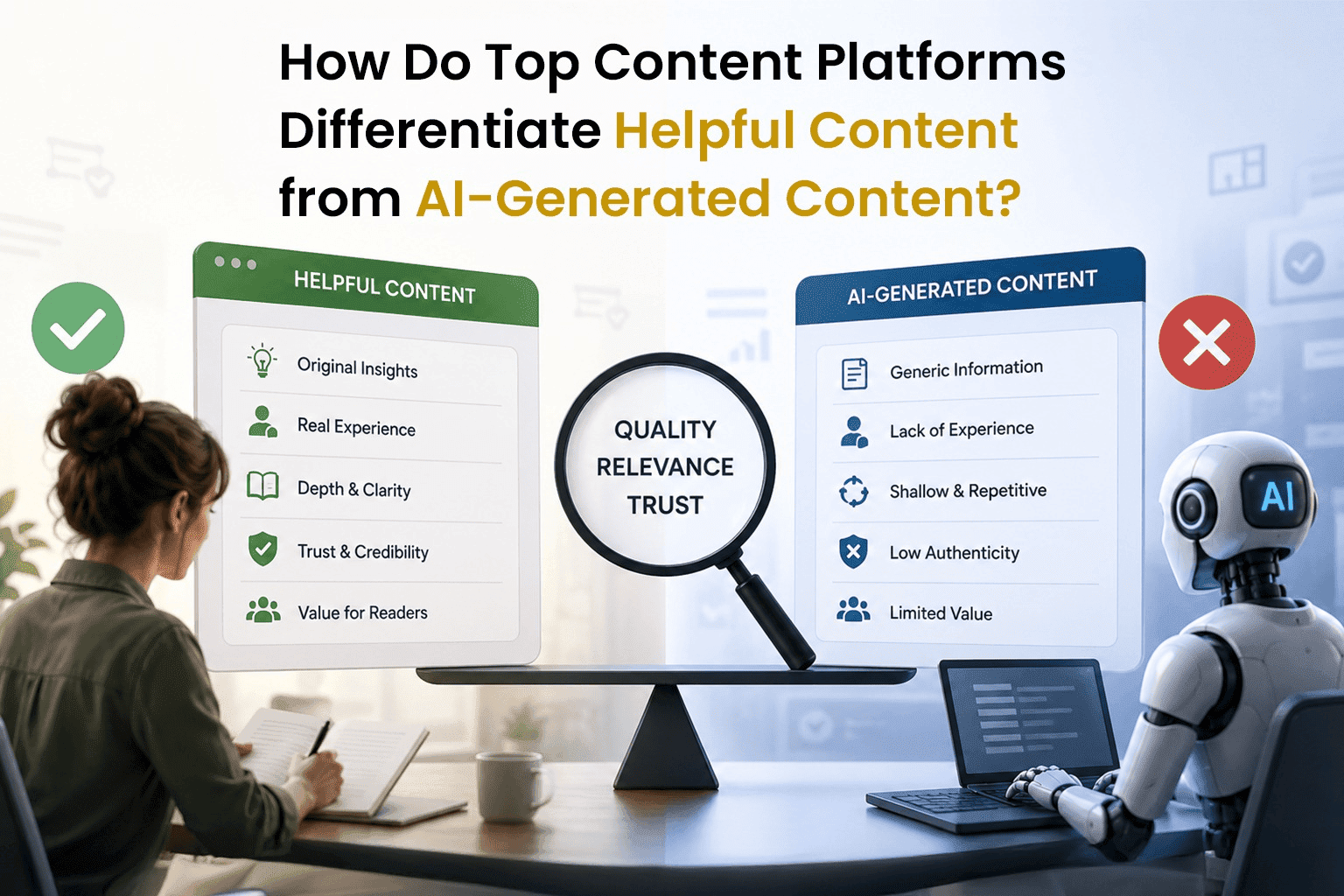
In 2026, the debate around AI content vs human content is reshaping how Google, LinkedIn, Medium, and every major platform ranks what you publish. AI has made content production faster than ever — but that speed has flooded the internet with low-effort, templated text that genuinely helps no one.
Top content platforms have responded by building systems to separate content that helps readers from content that just fills pages. If your content cannot pass these signals, it will not rank, get shared, or convert — regardless of word count.
At TechMozo, we help businesses across Delhi NCR and international markets build content that performs in this environment. Here is exactly how top platforms tell the difference — and what it means for your strategy.
1. What Is the Difference Between AI Content vs Human Content?
AI content vs human content comes down to one thing: origin of insight. AI-generated content is produced by large language models like ChatGPT or Gemini, which predict the most statistically likely word sequences based on training data. The output looks fluent and structured — but it draws from patterns in existing text, not lived experience.
What AI Content Lacks
No matter how advanced the model, AI-generated content consistently misses:
- First-person experience — a real practitioner describing what they have actually tested or built
- Original data — proprietary research, client case studies, metrics that exist nowhere else
- Cultural nuance — local context, industry-specific language, audience awareness
- Genuine perspective — a counterintuitive argument or professional opinion that no model generates unprompted
Where the Line Blurs
Most content in 2026 is neither purely AI nor purely human — it is AI-assisted. A writer uses AI for a first draft, then rewrites, adds original data, and inserts their own voice. Done well, this produces content that is efficient to create and valuable to read. The problem is when AI output is published without that human layer. That is what platforms are now specifically designed to catch.
2. Helpful Content vs AI Content: What Google Actually Rewards
The helpful content vs AI content distinction is the foundation of Google’s ranking philosophy. Google’s stated position is simple: it does not care how content was produced. It cares whether the content actually helps the reader.
Google’s Helpful Content System
Introduced in 2022 and strengthened through multiple core updates into 2026, Google’s Helpful Content System uses automated classifiers to evaluate whether content demonstrates real expertise, serves a specific audience, and would satisfy a reader without them needing to search again.
Critically, these are site-wide signals. A large volume of thin AI content on your domain suppresses the rankings of even your best pages.
The Four Signals Google Rewards
- People-first writing — content written for a real person with a real question, not written to rank
- Demonstrated experience — evidence the author has direct, relevant experience with the topic
- Original insight — a perspective or data point not available from a scan of existing top results
- Clear audience and purpose — specific content for a specific reader, not broad coverage for keyword capture
TechMozo’s Position on AI Content
At TechMozo, AI is a production tool, not a publishing button. We use it to draft and structure — but every piece that leaves our process has been rewritten, fact-checked, and enhanced by a human expert. That is the standard we recommend to every client.
3. How Does Google Know If Content Is AI Generated?
How does Google know if content is AI generated? The answer is not one detection tool — it is a combination of linguistic patterns, behavioural data, and the E-E-A-T framework working together.
Linguistic Signals: Perplexity and Burstiness
Two metrics reveal AI-generated text at scale:
- Perplexity — how predictable the word choices are. Human writers use unusual phrasing and unexpected transitions. AI defaults to statistically common choices, producing low perplexity scores.
- Burstiness — how much sentence length varies. Humans write in natural rhythms — short sentences mixed with longer ones. AI produces uniform sentence lengths that create a detectable flatness.
E-E-A-T: The Authenticity Framework
E-E-A-T — Experience, Expertise, Authoritativeness, Trust — is the framework Google’s quality raters use to evaluate every piece of content:
- Experience — has the author actually done what they are writing about?
- Expertise — is the author qualified? Signalled through bios, credentials, and content depth.
- Authoritativeness — is the source recognised by others? Backlinks and citations matter here.
- Trust — is the content accurate and transparent? Cited sources and clear attributions build this.
AI content structurally fails Experience and often Expertise — because it cannot show that a real, qualified person was involved.
Behavioural Signals
Google’s access to user behaviour data makes content quality hard to fake:
- Dwell time — readers leave thin AI content quickly when it doesn’t answer their actual question
- Scroll depth — specific, engaging content gets read deeply; generic content gets skimmed and abandoned
- Pogo-sticking — users clicking your result, leaving immediately, and clicking a competitor signal dissatisfaction and suppress rankings fast
4. How Other Platforms Detect AI Content
Google is not alone. Every major platform has built systems that reward authenticity and suppress generic, AI-sounding content.
LinkedIn’s algorithm rewards engagement quality over volume. Posts that generate genuine professional comments get amplified. AI-generated posts — even polished ones — consistently produce generic reactions and low dwell time. Phrases like “In today’s rapidly evolving landscape” and “It is important to note that” have become red flags that the algorithm now recognises and down-ranks.
For TechMozo‘s B2B clients, direct first-person posts with a specific professional observation consistently outperform comprehensive AI summaries in reach and engagement.
Medium and Substack
Medium’s curation team explicitly selects for original perspectives and personal narrative. Generic overviews are rarely chosen for distribution regardless of how well-structured they are. On Substack, reader loyalty is everything — subscribers unsubscribe from impersonal AI newsletters fast, and the platform’s recommendation engine penalises high churn.
AI Detection Tools Publishers Use
Beyond platform algorithms, publishers and agencies use third-party tools to screen content:
- Originality.AI — highest accuracy for GPT-4 and newer models, supports bulk scanning
- Copyleaks — combines plagiarism and AI detection across multiple languages
- Winston AI — highlights AI-generated passages sentence by sentence for targeted rewrites
- Turnitin — the academic standard, now used widely in publishing
TechMozo runs every client content deliverable through AI detection before publishing. Not to avoid AI — but to ensure the final output meets the quality bar every platform enforces.
5. How to Produce Content That Passes Every Test
The goal is not to avoid AI. It is to use AI without losing the human signals platforms reward.
The Four-Step Workflow
- Generate — use AI for a tight, focused first draft built around one specific user question
- Detect — run through an AI detection tool; flag sections with the highest AI probability
- Humanise — rewrite flagged sections with original insight, specific examples, and first-person observation
- Verify — fact-check every claim, add an author bio, add FAQ Schema, confirm the content fully answers the search intent
Six Signals Every Platform Rewards
Before publishing, confirm your content has all six:
- Named author with credentials — a byline and bio that establishes why this person is qualified
- Original data or case study — one piece of information not available in the top 10 results
- Cited sources — every factual claim backed by a named, credible reference
- FAQ Schema markup — structured data that gets your answers into AI Overviews and People Also Ask
- Publication and update date — visible dates signal freshness, which Google prioritises
- Specific intent match — one question answered fully, not a dozen topics loosely connected
AI Content vs Human Content: Quick Comparison
| Signal | Human Content | AI Content |
| First-person experience | ✅ Present | ❌ Absent |
| E-E-A-T compliance | ✅ High | ⚠️ Often fails Experience |
| Reader dwell time | ✅ Higher | ⚠️ Lower if thin |
| Google Helpful Content test | ✅ Passes with depth | ❌ Fails if unedited |
| Platform curation | ✅ Selected | ❌ Typically excluded |
| Long-term ranking stability | ✅ Stable | ❌ Vulnerable to updates |
Conclusion
The platforms shaping content visibility in 2026 are asking one question: does this content exist to help a real person, or to game a system? The signals they look for — direct experience, original insight, named expertise — are things AI cannot produce without a human layer behind them.
The businesses gaining ground right now are producing fewer, deeper, genuinely helpful pieces of content. Most competitors are publishing bulk AI content and watching rankings stagnate. The opportunity is real — but only for those willing to put the human work back in.
TechMozo helps businesses across Delhi NCR and internationally build SEO content strategies that combine keyword targeting with editorial quality. Contact us at info@techmozo.in or visit techmozo.in to get started.
Frequently Asked Questions
Does AI content rank on Google in 2026?
Yes — if it meets quality standards. AI-assisted content that is well-structured, accurate, and demonstrates clear authorship can rank. Thin, unattributed AI content that fails to satisfy search intent will not rank — and in volume, suppresses other pages on the same domain.
How does Google know if content is AI generated?
Google uses a combination of linguistic signals (predictable word choices, uniform sentence length), behavioural data (dwell time, scroll depth, pogo-sticking), and E-E-A-T evaluation (whether real expertise and experience are visible). No single signal determines it — the combination does.
What is the difference between helpful content vs AI content?
Helpful content is defined by its impact — does it fully answer a real question and leave the reader better informed? AI content is defined by its production method. These can overlap: AI-assisted content reviewed and enhanced by humans can absolutely be helpful. The problem is AI content published without human oversight.
Can AI content pass Google’s helpful content test?
Yes, but only with significant human input. Raw AI output lacks the Experience signal Google specifically rewards. AI-assisted content — where a human expert has added original data, a named author, and real-world examples — can pass and rank effectively.
What tools do agencies use to detect AI content?
The most widely used in 2026 are Originality.AI, Copyleaks, Winston AI, and Turnitin. TechMozo uses AI detection as a standard step in our content QA process for all client deliverables.