
Google Ads vs Meta Ads: Which Is Better for Lead Generation in 2026?
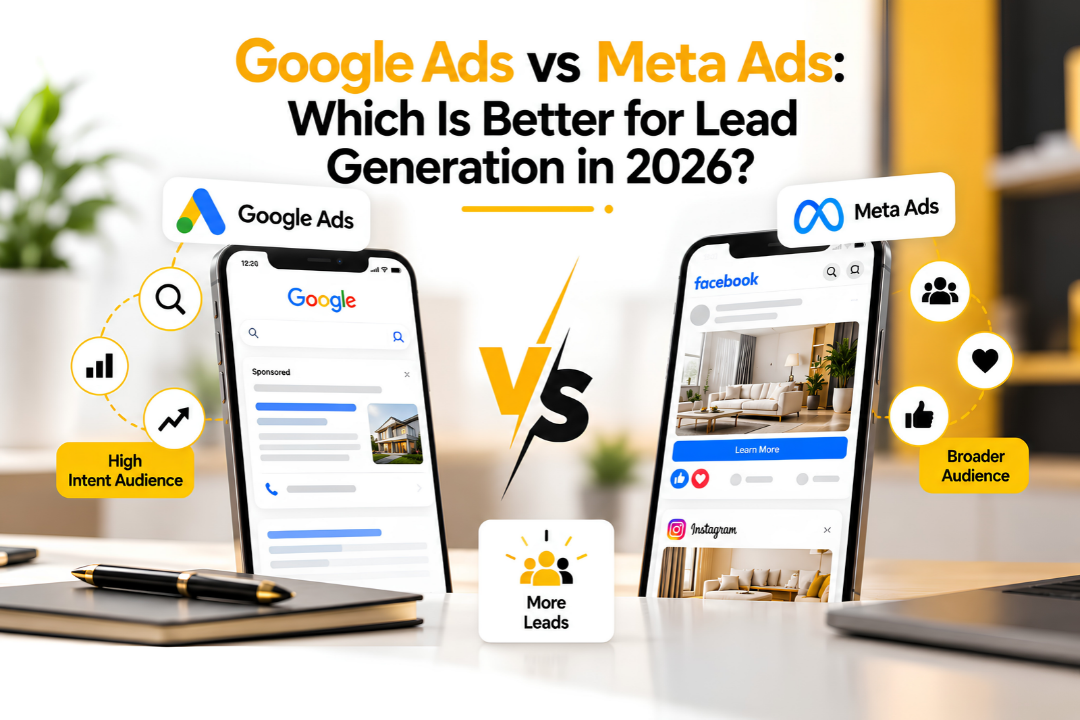
India’s digital ad spend is projected to hit ₹62,000 crore in 2026.
Every business owner running paid ads is asking the same question: Google or Meta?
It is the most common debate in performance marketing — and the most misunderstood one. Most businesses pick one, spend months on it, and either get results they cannot explain or waste budget they cannot recover. The answer is rarely as simple as choosing a winner. But understanding how each platform works — and when to use which — is the difference between a campaign that consistently generates leads and one that burns through budget with nothing to show.
Here is the honest breakdown.
1. The Core Difference That Changes Everything
Google Ads Works When Buyers Are Already Looking
Think about the last time you searched for a service on Google. You already had a need. You were comparing options and ready to act. That is exactly the mindset of every person your Google ad reaches.
Search advertising intercepts buyers at the moment of highest intent — when they have already decided they want something and are now deciding who to get it from. Your ad does not need to convince anyone that they have a problem. It simply needs to convince them that you are the right solution. That dynamic is why leads from Google Search tend to convert at higher rates and close faster than almost any other paid channel.
Meta Ads Works When Buyers Do Not Know You Exist Yet
Nobody opens Instagram to find a digital marketing agency or a real estate developer. They are there for entertainment, connection, and content. Meta Ads place your business in the middle of that experience — not because the user was looking, but because their profile suggests they are the type of person who might care.
This is demand creation rather than demand capture. The lead you generate through Meta is rarely ready to buy immediately. They need a follow-up sequence, a nurture process, and sometimes multiple touchpoints before they convert. But the volume is higher, the cost per lead is typically lower, and you are reaching people who would never have found you through a search query alone.
One Question That Decides Your Platform
Before spending a single rupee on either platform, ask yourself this: is there an audience actively searching for what I sell — or do I need to introduce the idea to them first?
High search volume, clear buyer intent, an established category — Google wins. New concept, visual product, interest-based audience, no existing demand — Meta wins. Most growing businesses eventually need both. But starting with the right one first saves months of budget and trial-and-error.
2. Where Google Ads Delivers for Indian Businesses
The Categories Where Google Ads Works Best
Google Ads thrives wherever a buyer is actively researching a solution before committing. In the Delhi NCR market and across India, the business types that consistently generate strong leads through Google Search include:
- Real estate: A buyer typing “3BHK in Sector 62 Noida” or “ready-to-move flat Dwarka” is deep into the decision process — they are comparing, not discovering
- Professional services: When someone searches for a chartered accountant, immigration lawyer, or financial advisor, they are already in hiring mode — the search itself signals purchase readiness
- B2B services: Software vendors, IT companies, logistics providers, and consulting firms are found almost exclusively through search — the decision-maker is evaluating, not scrolling
- Local and hyperlocal businesses: Repair services, clinics, salons, coaching institutes, and driving schools live or die by local search — and “near me” queries convert at rates very few other formats can match
Where Google Ads Hits Its Limits
When a product or service is too niche to have meaningful search volume, or when a buyer would not think to search for it by name, Google Ads runs out of road. Competitive categories with CPCs above ₹300–₹400 per click also become difficult to sustain on a small budget — the math simply does not work unless your average customer value is high enough to justify the acquisition cost.
Benchmarks for Google Ads in Delhi NCR and India
Well-structured Google Search campaigns in India typically land at: ₹300–₹700 CPL for local service businesses, ₹600–₹900 CPL for real estate, and 3x–6x ROAS for e-commerce with tight keyword and landing page alignment. These figures assume proper conversion tracking is in place before the first ad goes live — without it, the data that drives optimisation simply does not exist.
3. Where Meta Ads Delivers for Indian Businesses
The Categories Where Meta Ads Works Best
Meta’s strength is volume, visual impact, and the ability to reach audiences who fit your buyer profile even when they were not thinking about you. Across India, the business types generating consistent results on Meta include:
- D2C and consumer products: Any product that benefits from being seen — fashion, food, wellness, home goods — belongs on Instagram and Facebook where discovery is baked into the experience
- Education and skill development: Courses, diplomas, bootcamps, and coaching programmes reach their target demographic through interest and life-stage signals rather than search queries
- Event-based and seasonal businesses: Wedding planners, tour operators, fitness challenges, and seasonal launches benefit from Meta’s ability to build awareness quickly across a large, targeted audience
- Service businesses with a visual story: Gyms, salons, restaurants, interior designers — any business where the quality of the work can be shown performs strongly in a visual-first feed environment
Where Meta Ads Hits Its Limits
The primary challenge with Meta leads is conversion readiness. A lead captured through a Facebook form is rarely at the same buying temperature as someone who searched Google for the same solution. Without a structured follow-up process — WhatsApp sequences, call scripts, email nurture — Meta leads expire fast. Agencies that judge Meta’s performance purely on cost per lead without tracking lead-to-customer conversion are making an expensive mistake.
Benchmarks for Meta Ads in India
Realistically managed Meta campaigns in India produce: ₹150–₹450 CPL for consumer and education categories, ₹250–₹600 CPL for service businesses using lead forms, and 4x–8x ROAS for e-commerce brands using Dynamic Product Ads with proper pixel setup. Using a dedicated landing page instead of a native Meta lead form typically improves lead quality significantly for any offer above ₹10,000.
4. Google Ads vs Meta Ads: A Direct Comparison
How the Two Platforms Stack Up
| What to Compare | Google Ads | Meta Ads |
| Buyer mindset | Actively searching for a solution | Passively browsing, not looking to buy |
| Lead readiness | High — close to a decision | Lower — needs nurturing first |
| Lead volume | Lower at the same budget | Higher at the same budget |
| Typical CPL in India | ₹300–₹900 | ₹150–₹500 |
| Strongest use case | B2B, local services, high-ticket | D2C, education, discovery products |
| Creative demand | Minimal — copy and keywords | High — visuals, video, strong hooks |
| Optimisation timeline | Results visible sooner | 2–3 week learning period required |
| Follow-up dependency | Low to moderate | High — critical to ROI |
The ROI Question Nobody Is Asking Correctly
Most business owners compare platforms on cost per lead. That is the wrong metric. A lead that costs ₹900 on Google and converts to a customer at 18% is worth more than a lead that costs ₹250 on Meta and converts at 3%. The number that actually matters is cost per customer — and that calculation includes not just the platform cost but the quality of your follow-up, your offer strength, and your sales process.
Run both platforms long enough to track the full journey from ad click to closed customer. That data — not the CPL dashboard — is what should be driving your budget decisions.
5. How to Choose the Right Platform for Your Business
Start With Google Ads If
You operate in a category with clear buyer intent and reasonable search volume. Your average customer value justifies a CPL above ₹500. You serve a local or city-specific audience where search queries with location terms drive business. Your conversion happens quickly once someone reaches your website or calls.
Start With Meta Ads If
What you sell benefits from being seen before it is searched for. Your buyer profile is defined by demographics, interests, or life stages rather than specific search behaviour. Your monthly budget is under ₹20,000 and you need lead volume to identify what messaging resonates. You are entering a new market or launching a product with little existing search demand.
Run Both When You Are Ready to Scale
Splitting budget across both platforms too early produces underwhelming results on each. The smarter path is to establish what works on one platform first — a proven CPL, a working follow-up system, a converting landing page — and then expand to the second. At that point, Google captures buyers who are already searching and Meta warms up the audience who will be searching in the coming weeks. Together they build a pipeline that neither could build alone.
6. What TechMozo Recommends Before Spending on Either Platform
Fix the Infrastructure Before the Ads Go Live
Conversion tracking, pixel setup, GA4 configuration, landing page quality, and follow-up speed — these determine whether ad spend turns into revenue. Skipping any of them means you are flying blind. TechMozo audits all of these before a client’s first campaign launches, because the infrastructure is what the results are built on. Contact our team to get an infrastructure audit before you spend a rupee.
Treat the First 30 Days as a Learning Phase, Not a Delivery Phase
No platform delivers its best results in week one. The first month is for establishing baselines — what CPL looks like, which audiences respond, which creative angles cut through, what happens after someone fills in a form. Businesses that judge a campaign by its first two weeks almost always make the wrong call. TechMozo sets client expectations around a 60-day window before drawing any firm conclusions about platform performance.
Let the Data Decide, Not the Preference
The only valid reason to increase budget on a platform is that the data shows it is working. Cost per lead is trending down. Conversion rate from lead to customer is tracking above benchmark. Follow-up response times are fast. When all of these are moving in the right direction together, scaling is a sound decision. When any of them is broken, more budget makes the problem bigger, not smaller.
Conclusion
The Google vs Meta question has no universal answer — and any agency that gives you one without understanding your business first is telling you what sounds convincing rather than what is true.
Google puts your business in front of people actively looking for what you offer. Meta puts it in front of people who match the profile of someone who will want it. Both are powerful. Both can waste your money if used incorrectly. And both work significantly better when the system around them — tracking, landing pages, follow-up, and creative — is built before the first rupee goes in.
TechMozo manages Google Ads and Meta Ads for small businesses and growing brands across Delhi NCR and India — built around leads, cost per acquisition, and measurable revenue. Reach us at info@techmozo.in or visit techmozo.in to start a conversation.
Frequently Asked Questions
Which platform gives a lower cost per lead in India — Google or Meta?
Meta Ads typically produce a lower CPL in India, particularly for consumer and education categories where ₹150–₹450 is achievable with strong creative. Google CPLs tend to sit higher at ₹300–₹900 depending on the category. The lower cost on Meta does not automatically mean better value — lead quality and conversion rates need to be factored in before drawing any conclusions about which is more cost-effective for a specific business.
Is Google Ads always better for B2B lead generation?
For most B2B categories, yes. A procurement manager or business owner researching a vendor almost always starts with a search query — not a social media scroll. Google Search captures that intent directly. Meta can support B2B campaigns through demographic and job title targeting, but the lead quality gap is significant for high-ticket or long-cycle B2B sales.
Should a small business run Google and Meta Ads at the same time?
Not if the budget is limited. Running both simultaneously on a small budget — say ₹15,000–₹25,000 per month — splits resources before either platform has enough data to optimise effectively. Start with one, generate enough data to prove the system, then layer in the second. The combined strategy becomes genuinely powerful once each platform’s foundation is working.
How quickly do results appear on each platform?
Google Search campaigns can generate enquiries within 24–48 hours of launch when targeting and landing pages are correctly set up. Meta requires a learning phase of roughly 7–14 days before its algorithm begins delivering consistently. Both platforms typically take 45–60 days of managed optimisation before CPLs stabilise at a level that makes scaling worthwhile.
How does TechMozo decide which platform to start with for a new client?
TechMozo looks at four things before making any platform recommendation: the nature of the product or service, whether buyers are searching for it or need to discover it, the client’s budget relative to the category’s CPL benchmarks, and whether a follow-up system is already in place to handle incoming leads. The right platform is the one that fits those four realities — not the one that sounds more sophisticated or is currently trending.